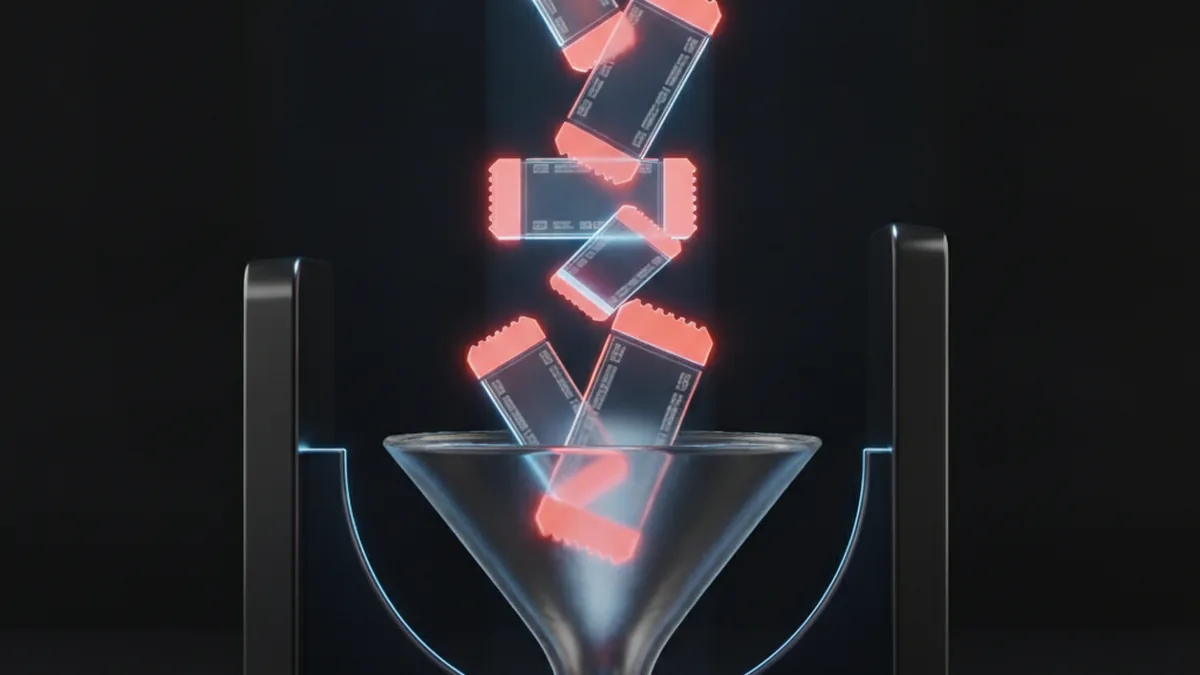
Segment marketing splits your audience into groups that share a need, then sends each group a message that fits. Start with two or three segments built from data you already have.
- A good segment shares a need, not just a label
- Behaviour usually predicts buying better than demographics
- Start small: two or three segments, one message each
Segment marketing means dividing your audience into groups that have something meaningful in common, then talking to each group differently. Same business, same product, different message, offer or timing.
The alternative is one message for everyone. It is simpler to send and easier to ignore. A first-time visitor, a loyal customer and someone who cancelled last month don't want to hear the same thing.
What makes a useful segment
A segment is useful when the people in it would respond to the same message, and differently from people outside it. 'Customers in Manchester' is only a segment if location changes what you'd say to them. 'Customers who bought once and never returned' almost always is.
Check every segment against three questions. Is it big enough to bother? Can you reach it with the data you have? Would you actually say something different to it? If any answer is no, merge it into something broader.
The main ways to segment
| Type | Based on | Small business example |
|---|---|---|
| Demographic | Age, role, life stage | Students versus working professionals |
| Firmographic | Company size, industry | Sole traders versus firms with 20 staff |
| Geographic | Location, region, climate | Customers within delivery range |
| Behavioural | What people do | Opened pricing page twice this week |
| Value | What they spend or could spend | Top 10% of customers by annual spend |
| Needs-based | The problem they want solved | Wants speed versus wants lowest price |
For most small businesses, behavioural and value segments do the heaviest lifting. They are built from facts you already record, and they change as people's actions change, so your segments stay current without extra work.
Three worked examples
A bike shop. One list becomes three segments: commuters who buy parts often, weekend riders who buy a bike every few years, and families buying for children. Commuters get a service reminder every three months. Weekend riders get early access to new models in spring. Families get a size-up reminder a year after purchase.
An accountancy firm. Segment by business type and deadline. Sole traders get a plain reminder and a checklist six weeks before their tax deadline. Limited companies get a year-end planning invitation. New sign-ups get a short series explaining what the firm needs from them and when.
A software subscription. Segment by usage. Trial users who haven't completed setup get a help email. Active trial users get a pricing nudge on day 10. Paying customers whose usage drops by half get a check-in from a real person.
Building your first segment from CRM data
You don't need new data to start. Your CRM already holds purchase dates, deal values, sources and activity. Say you have 400 contacts. A simple first split might look like this:
- Bought in the last 90 days: thank them and suggest a natural next purchase.
- Bought before, nothing in the last year: a short 'what's new' with one clear offer.
- Never bought, engaged recently: a case study and an easy first step.
- Never bought, no engagement in a year: one re-permission email, then stop.
Four segments, four messages, all built from two fields: last purchase date and last activity date. In Salesformics you can build this as a saved filter, or type contacts no purchase in 12 months in the GX Box and save the result as a segment.
Turning segments into automation
Segments become powerful when they trigger things. When a contact enters the 'lapsed customer' segment, a workflow can send one email, wait a week, create a call task for the owner if they opened it, and stop if they buy. In a drag-and-drop workflow builder this is four boxes and three arrows.
Keep each workflow short. Long, branching sequences are hard to test and easy to break. Several short workflows, each tied to one segment and one goal, are easier to maintain and easier to measure.
B2B and B2C segments work differently
If you sell to consumers, segments are usually built around individuals: what they bought, how often and how recently. If you sell to businesses, the company matters as much as the person. A segment might be 'firms with 10 to 50 staff in hospitality where the main contact is the owner'.
In B2B, also segment by role. The finance director and the operations manager at the same company care about different things. One wants cost and risk. The other wants time saved. Same product, two messages, both landing in the same building.
Consent comes before segments
A segment is only as good as your right to contact the people in it. Record how and when each contact gave consent, and respect opt-outs at once. Under UK and EU rules this is not optional, and it is also good practice: people who chose to hear from you respond better.
Build consent into the segment itself. Every marketing segment should include a condition such as 'marketing consent is yes'. Then nobody can accidentally email the wrong people by building a new filter in a hurry.
Common mistakes
- Too many segments. Twelve segments means twelve messages to write and maintain. Start with three.
- Segments nobody acts on. If a segment doesn't get its own message, it isn't a segment, it is a report.
- Overlap without rules. Decide which segment wins when someone qualifies for two, or they will get two emails on the same day.
- Never reviewing. Check results each quarter. Merge segments that respond the same way, split ones that don't.
How to measure it
Compare each segment against its own goal, not against an average. A win-back email with a modest reply rate may be a great result. A thank-you email with the same rate may be weak. Track one number per segment: purchases, replies, booked calls or renewals, whatever that segment is meant to produce.
Give each new segment at least a few weeks before judging it. Small lists produce noisy results, and one good or bad week can mislead you. Look for a steady difference, then decide.
Segment marketing is not about being clever. It is about not sending the wrong message to people who have already told you, through their actions, what they need.
Questions
What is the difference between segmentation and personalisation?
Segmentation groups people and sends each group a shared message. Personalisation adjusts details for each individual, such as a name or last product bought. Most small businesses get more from good segments than from heavy personalisation.
How many segments should a small business have?
Start with two to four. Add more only when you have a distinct message for the new group and the time to maintain it.
Do I need special software for segment marketing?
You need a CRM that can filter contacts on fields like purchase date and activity, and an email or workflow tool that can act on those filters. Many small business CRMs include both.